

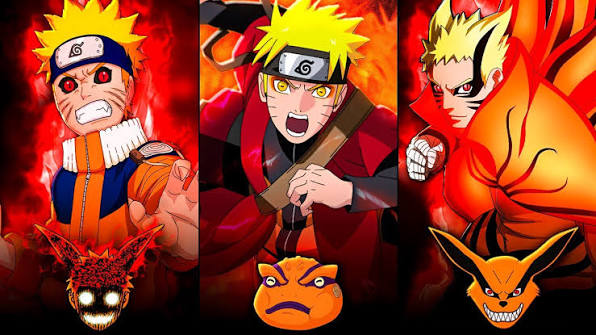
Naruto undergoes some of the most spectacular transformations in anime history, evolving from an inexperienced young ninja into one of the most powerful shinobi ever seen. His abilities change dramatically throughout Naruto, Naruto Shippuden, and Boruto, reflecting his growing understanding of chakra, combat, and the mysterious Nine-Tailed Fox sealed inside his body. Each new form introduces unique powers, but also comes with limitations that influence how Naruto approaches his battles.
His earliest transformations are driven by Kurama’s chakra, a dangerous source of energy that initially threatens to overwhelm his personality. As Naruto develops his skills, he learns to access this immense power without losing control. His journey also introduces Sage Mode, an advanced technique that uses natural energy to enhance physical abilities and sensory perception. These developments gradually transform Naruto from a fighter who relies on determination into a shinobi capable of confronting legendary opponents. Every transformation marks an important change in both his strength and his relationship with Kurama.
The visual evolution of these powers has become inseparable from Naruto’s popularity. His orange chakra cloaks, distinctive eyes, and increasingly elaborate forms are instantly recognizable to fans. These designs have influenced countless illustrations, collectibles, and anime figures inspired by his most memorable battles. Yet the appeal of each transformation extends beyond its appearance. Understanding how these abilities work reveals why Naruto can defeat certain enemies, why other opponents remain dangerous, and how the limitations of his strongest techniques shape his destiny.
How did Naruto’s Nine-Tails transformations begin?
Naruto’s earliest transformations originate from Kurama, the Nine-Tailed Fox, sealed inside him shortly following his birth. This connection gives Naruto access to an enormous reserve of chakra, although he initially lacks the experience needed to control it properly. Strong emotions, particularly anger and desperation, often trigger the release of the fox’s energy. The resulting power increases Naruto’s physical abilities but threatens his mental stability.
During his confrontation with Haku, Naruto experiences one of his earliest significant manifestations of the Nine-Tails’ chakra. His eyes change, his whisker-like facial markings become more pronounced, and his strength rises dramatically. This initial Nine-Tails chakra transformation provides exceptional speed, enhanced endurance, and improved healing. Unlike the controlled abilities he develops later, these early transformations depend heavily on his emotional condition.
The original chakra cloak becomes particularly memorable as Naruto develops more visible manifestations of Kurama’s power. Its reddish energy and aggressive appearance are recreated in illustrations and Naruto figures depicting his transformations from Naruto Shippuden. Beneath this recognizable design, however, lies a serious danger: the more chakra Naruto releases without control, the greater the risk that Kurama will influence his actions.
The One-Tailed Cloak represents another important development. During Naruto’s battle against Sasuke at the Valley of the End, a visible chakra tail forms behind him, significantly improving his mobility and offensive capabilities. The cloak also protects his body and allows his chakra to act in unusual ways, extending his movements beyond normal physical limitations.
As Naruto’s emotional instability increases during Naruto Shippuden, he manifests additional tails. His Four-Tailed Transformation is especially dangerous because his appearance becomes increasingly monstrous and his conscious control deteriorates. His chakra can inflict serious damage, while his destructive attacks become powerful enough to overwhelm experienced opponents. Higher-tailed manifestations are even more difficult to contain, demonstrating that possessing immense chakra does not automatically mean mastering it.
Sage Mode and Naruto’s mastery of natural energy
Naruto’s Sage Mode introduces a completely different approach to increasing his strength. Rather than relying on Kurama, Naruto learns to combine natural energy with his physical and spiritual energy to produce senjutsu chakra. He develops this ability through training at Mount Myoboku under Fukasaku, following the teachings associated with Jiraiya and the toads.
The transformation gives Naruto distinctive orange pigmentation around his eyes and horizontal pupils. More importantly, it significantly enhances his strength, reflexes, durability, and sensory perception. He becomes capable of detecting chakra signatures and anticipating enemy movements without relying exclusively on ordinary sight.
One of Sage Mode’s most impressive advantages is its ability to strengthen Naruto’s existing techniques. His Rasengan becomes considerably more powerful, while the Rasenshuriken can be thrown as a devastating ranged attack. Natural energy also allows Naruto to use Frog Kata, a fighting style that extends the effective reach of his taijutsu through invisible senjutsu energy.
During his battle against Pain, Sage Mode proves that Naruto can confront a formidable enemy without depending entirely on the Nine-Tails. His improved physical abilities and heightened perception help him challenge the Six Paths of Pain, although he still needs tactical planning and assistance to overcome their different techniques.
The transformation has significant restrictions. Naruto must remain still to gather natural energy efficiently, and maintaining the necessary balance requires concentration. At this stage of his development, Sage Mode lasts only for a limited period, although Naruto compensates by preparing shadow clones capable of gathering natural energy elsewhere. This limitation makes strategic chakra management essential, reinforcing the importance of intelligence alongside raw strength.
Kurama Chakra Mode and the evolution of Naruto’s power
Kurama Chakra Mode marks a major turning point in Naruto’s abilities. Rather than allowing the Nine-Tails’ chakra to emerge through emotional outbursts, Naruto learns to harness its power deliberately. His glowing golden appearance reflects a new level of control and introduces abilities far beyond those of his earlier red chakra cloaks.
KCM1 and Naruto’s control over the Nine-Tails
The first version, commonly called KCM1, emerges when Naruto separates and takes control of a portion of Kurama’s chakra during training with Killer B’s assistance. His body becomes surrounded by golden energy, decorated with dark markings that distinguish the transformation from his earlier forms. Although Kurama does not willingly cooperate at this stage, Naruto gains a much more reliable method of using the fox’s power.
KCM1 dramatically increases Naruto’s speed, reaction time, and combat effectiveness. His movements become fast enough to challenge opponents who specialize in exceptional physical speed. The transformation also improves his sensory abilities, allowing him to detect hostile intentions, an advantage that becomes particularly valuable during the Fourth Great Ninja War.
Another important ability involves chakra arms, extensions of energy that Naruto can manipulate to attack, defend, and interact with objects. These extensions provide remarkable flexibility during combat, allowing him to strike from unexpected angles without physically approaching an enemy.
Despite these advantages, KCM1 is not the final stage of Naruto’s relationship with Kurama. The chakra he uses is obtained through force rather than genuine cooperation. This distinction becomes crucial as Naruto discovers that mutual trust can unlock abilities unavailable through simple domination.
KCM2 and the complete partnership with Kurama
KCM2, often called Kurama Mode, develops when Naruto and Kurama establish a genuine partnership during the Fourth Great Ninja War. Their relationship changes from one defined by resentment and imprisonment into cooperation based on mutual understanding. This emotional development produces one of the most significant improvements in Naruto’s overall combat potential.
With Kurama willingly sharing his chakra, Naruto gains access to more powerful energy reserves and greater control over his transformations. His golden cloak becomes more elaborate, and he can distribute chakra to other shinobi, strengthening their capabilities and providing protection during large-scale battles.
The most spectacular ability introduced through this partnership is Tailed Beast Mode. Naruto manifests a giant chakra avatar resembling Kurama, allowing him to fight enormous opponents and defend against destructive attacks. Unlike transformations that physically reshape him into a beast, this mode surrounds Naruto with an immense construct of chakra.
Within this form, he can unleash a Tailed Beast Bomb, an extraordinarily destructive technique created by balancing positive and negative chakra. Naruto can also combine his avatar’s physical strength with his own tactical abilities, making the transformation effective against both individual enemies and massive battlefield threats.
KCM2 demonstrates that Naruto’s greatest improvements do not always come from acquiring a completely new power. Sometimes, learning to cooperate with an existing source of strength produces far greater results than attempting to control it alone.
Six Paths Sage Mode and the power of Hagoromo
Six Paths Sage Mode represents one of Naruto’s most extraordinary transformations. He receives Six Paths power through Hagoromo Otsutsuki during the Fourth Great Ninja War, gaining abilities connected to a level of chakra far beyond ordinary shinobi techniques. This power allows him to confront opponents such as Madara Uchiha and Kaguya Otsutsuki.
One of the transformation’s recognizable features is the appearance of cross-shaped pupils without the orange pigmentation typically associated with his traditional Sage Mode. When Naruto combines this power with Kurama’s chakra, his appearance becomes even more elaborate, reflecting the interaction between different sources of energy.
The transformation greatly enhances Naruto’s physical capabilities, sensory perception, and mastery of senjutsu. His abilities become powerful enough to challenge enemies who possess chakra associated with the Ten-Tails. His reactions and awareness also improve, allowing him to perceive threats that ordinary ninja cannot detect.
During the war, Naruto demonstrates access to Truth-Seeking Balls, mysterious black spheres containing multiple chakra natures. They can be manipulated for offensive and defensive purposes, while their unusual properties make them exceptionally dangerous against conventional ninjutsu. Naruto’s Six Paths abilities also include remarkable restorative feats, demonstrated when he saves Might Guy from the immediate consequences of opening the Eighth Gate and restores Kakashi’s missing eye.
His enhanced Six Paths Senjutsu also enables advanced Rasenshuriken variations incorporating chakra from different tailed beasts. These techniques give Naruto access to a broader range of offensive effects than his traditional wind-based attacks.
Nevertheless, Six Paths Sage Mode should not be confused with every transformation that displays a golden chakra cloak. Its distinctive abilities originate from Hagoromo’s power, while the chakra avatar associated with Kurama represents another aspect of Naruto’s abilities. Understanding this distinction is essential when comparing Naruto’s strongest forms.
Why is Baryon Mode Naruto’s most dangerous transformation?
Baryon Mode appears during Naruto’s confrontation with Isshiki Otsutsuki in Boruto. At this point, Isshiki’s overwhelming speed and strength make conventional techniques insufficient. Kurama reveals a previously unknown transformation capable of producing a dramatic increase in Naruto’s combat abilities, although its activation carries an extraordinary price.
Unlike Kurama Chakra Mode, which allows Naruto to draw upon the fox’s chakra, Baryon Mode uses the chakra of both Naruto and Kurama as fuel for an entirely different energy-producing process. Kurama compares this mechanism to nuclear fusion, emphasizing that the transformation consumes the energy sustaining their existence.
The visual changes are unmistakable. Naruto develops fox-like features, dark markings around his eyes, and a reddish-orange chakra cloak with prominent extensions resembling tails. His physical performance improves dramatically, giving him the speed, reflexes, and precision needed to overpower Isshiki during close combat.
Baryon Mode also possesses an unusual offensive property. Physical contact with Naruto reduces his opponent’s remaining lifespan. Against Isshiki, whose available lifetime is already extremely limited, this ability proves particularly effective. Each successful exchange contributes to shortening the time Isshiki can remain alive.
The greatest disadvantage is its extreme energy consumption. Baryon Mode cannot be maintained for long, and unnecessary movements accelerate the depletion of its limited resources. Naruto must therefore focus on precise attacks rather than prolonged exchanges or wasteful techniques.
The transformation ultimately results in Kurama’s death, fundamentally changing Naruto’s abilities. While Naruto survives, he permanently loses access to the Nine-Tails’ chakra and the transformations dependent on it. Baryon Mode consequently stands apart from his previous power-ups because its incredible strength requires an irreversible sacrifice.
What powers does Naruto retain without Kurama?
Following Kurama’s death, Naruto no longer possesses the enormous chakra reserves and special transformations associated with the Nine-Tails. His loss includes Kurama Chakra Mode, the giant fox avatar, and Baryon Mode. These changes significantly reduce his maximum destructive potential, especially when compared with the extraordinary abilities he demonstrated during the war and his battle against Isshiki.
However, losing Kurama does not erase Naruto’s personal achievements as a shinobi. He retains his experience, tactical intelligence, exceptional determination, and mastery of many techniques developed through years of training. Most importantly, Sage Mode remains available because its energy comes from nature rather than the Nine-Tails.
Naruto can still use shadow clones, the Rasengan, taijutsu, and various combat strategies. His understanding of chakra manipulation and his capacity to adapt during difficult confrontations remain important strengths. Sage Mode continues to improve his sensory abilities and physical performance, allowing him to operate far beyond the capabilities of ordinary ninja.
The loss of Kurama also changes the way Naruto must approach powerful enemies. Without a near-limitless external chakra source, prolonged combat and unnecessary energy consumption become more dangerous. He must rely increasingly on accurate judgment, efficient techniques, and cooperation with his allies.
Among all his transformations, Baryon Mode offers the most dramatic short-term physical enhancement demonstrated against Isshiki, while Six Paths Sage Mode provides a broader collection of extraordinary abilities. Kurama Chakra Mode remains particularly valuable for large-scale battles, and traditional Sage Mode demonstrates the strength Naruto developed through his own training.
These distinctions explain why identifying Naruto’s strongest form depends on the situation. A transformation capable of defeating an overwhelmingly powerful enemy during a brief confrontation is not necessarily the most sustainable option. Naruto’s evolution ultimately shows that his abilities are defined not only by the amount of chakra he possesses, but also by how effectively he understands and uses it.